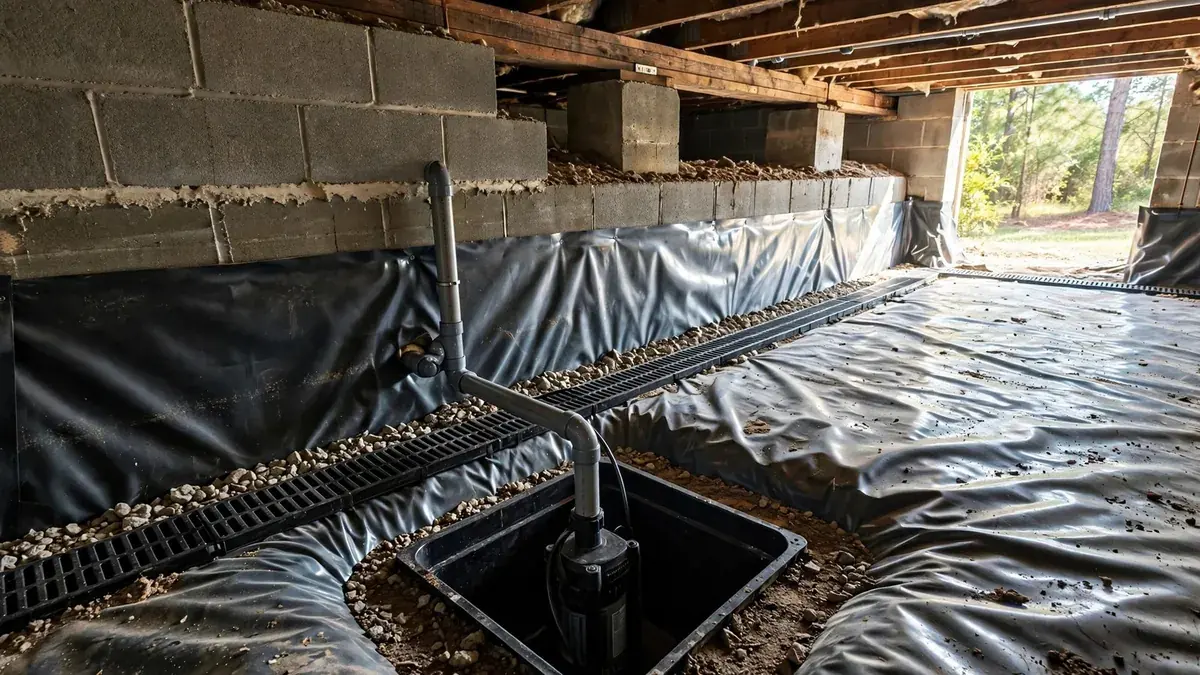
Waterproofing paint can seal damp concrete and stop minor moisture, but it cannot stop water that is pushing up through the slab. If your basement floor is only damp, paint may help. If it shows standing water, wet spots after rain or white powder that returns, paint will peel and the water will win. A simple plastic sheet test tells you which problem you have.
What Waterproofing Paint Is
Masonry waterproofing paint is a thick coating that fills pores in concrete and forms a barrier on the surface. It is not the same as a floor epoxy, which is a hard decorative coating for traffic. Some products combine both, but check the label for the water pressure the product can hold. Most paints resist moisture vapor, not hydrostatic pressure.
Damp or Leaking: The Plastic Sheet Test
Dry the spot
Wipe a patch of floor or wall and let it dry.
Tape plastic
Tape a square of plastic sheeting tightly on all edges.
Wait a day or two
Leave it for 24 to 48 hours.
Look at the plastic
Moisture on the room side means condensation. Moisture under the plastic means water is coming through the concrete.
If the underside of the plastic is wet, water is moving through the slab. Paint is unlikely to hold. If the room side is wet, humidity is the issue, and a dehumidifier or better ventilation may solve it.
When Paint Is Worth Trying
Paint suits these conditions
- Slightly damp concrete that dries between storms.
- A basement with a dehumidifier that still has a musty smell.
- Minor efflorescence after cleaning and drying.
- Sealing a floor before a finish coat, once water sources are fixed.
- Walls without active seepage.
How to Prepare the Surface
Paint fails more from poor prep than from a weak product. Clean the surface with a stiff brush and a degreaser. Remove old paint, sealer and mineral deposits. Fill cracks with hydraulic cement, which sets even when damp. Patch holes and let everything cure. Apply the paint in thin coats, following the product's directions for drying time between coats.
Why Paint Peels
Water pressure is stronger than a coating. When groundwater rises under the slab, it pushes against the paint from below, lifting it in blisters. Salts carried by the water crystallize behind the paint and flake it off. A coating over a leak is only a cover, and the leak gets worse.
| Condition | Paint | Better fix |
|---|---|---|
| Damp, no standing water | May help | Dehumidifier plus paint. |
| Water along floor-wall joint | Will fail | Interior drain and sump. |
| Active cracks leaking | Will fail | Crack injection or repair. |
| Plumbing leak | Useless | Leak detection and repair. |
| Water table pushing up | Will fail | Sump system, drainage. |
Magna Note: Cracks After the 2020 Earthquake
The Utah earthquake program reports that the March 18, 2020 magnitude 5.7 earthquake caused damage throughout the valley, with the most severe damage in Magna, including failure of unreinforced masonry in downtown buildings. A HAZUS estimate in the same report put building-related damage at upwards of $62 million, excluding public infrastructure.
Basements and foundations that moved in that event or in aftershocks can have hairline cracks that did not leak at first. If your floor or wall has a crack that now weeps, paint will not bridge it. Have the crack repaired first, then decide whether a coating adds anything.
What Actually Fixes Basement Floor Water
If water comes in at the floor-wall joint or rises through the slab, an interior drain collects it and sends it to a sump pit. If a plumbing leak is the source, repairing the pipe ends the problem. See basement waterproofing for the drainage approach, and leak detection to rule out a supply leak.
Homeowners in Kearns and Taylorsville often start with paint, and it works when moisture is the only issue. The test above saves you from a failed weekend project.
Choosing the Right Product
Read the label for what the coating is designed to resist. Some masonry sealers resist dampness and vapor. A few resist limited water pressure on walls. Few are rated for floors under water pressure. Look for a product that states the pressure it handles, and be wary of marketing words like waterproof without any numbers behind them.
| Type | Good for | Poor for |
|---|---|---|
| Masonry waterproofing paint | Damp walls and floors, light moisture | Standing water, pressure. |
| Epoxy floor coating | Hard-wearing garage and utility floors | Wet slabs, moisture vapor. |
| Penetrating sealer | Concrete that is not under a finish | Cracks and active leaks. |
| Crystalline waterproofing | Damp concrete under mild pressure | Moving cracks. |
A Realistic Plan for a Damp Basement
Fix the outside first
Extend downspouts, slope soil away and clear window wells.
Run the plastic test
Learn whether moisture comes from the slab or the air.
Dehumidify
Hold the air near 50 percent relative humidity.
Repair cracks
Use hydraulic cement or injection for active cracks.
Coat last
Apply paint only when the slab stays dry on its own.
Painting at the end gives the coating a dry surface to bond to. Painting at the start covers the problem and hides what the plastic test would have shown.
Cost, Time and Risk of the Paint Route
Paint is inexpensive and fast compared with drainage work, which is why it tempts people. The risk is that a failed coating costs you the paint, the labor and a season of time while the water problem gets worse. If the plastic test shows moisture coming through the slab, skip the paint and ask for an assessment. If it shows humidity only, paint can be a reasonable finish.
If You Plan to Finish the Basement
Never finish a basement over an active moisture problem. Carpet, framing and drywall hold water, and mold follows. Solve the water first with grading, drainage or a pump, then verify for a few wet seasons before you build. A plumber can tell you which solution fits your lot before you spend on framing.
Read the Technical Data Sheet
Manufacturers publish technical data sheets that state what a coating resists and under what conditions. Read yours before you buy, and look for the line that says whether the coating resists vapor only or also some water pressure. Utah applies the International Plumbing Code (IPC) with statewide amendments, and your city or county building department enforces it.
Basement Waterproofing Paint Questions
No. It resists moisture, not pressure from standing water.
Not without cleaning. Mineral salts push the coating off.
No. Epoxy is a hard wear coating, and it can fail over a wet slab.
The state report documents damage throughout the valley, with the most severe in Magna. Check old cracks for new seepage.
If it appears after storms or snowmelt and the plastic test shows moisture coming up, it is groundwater.