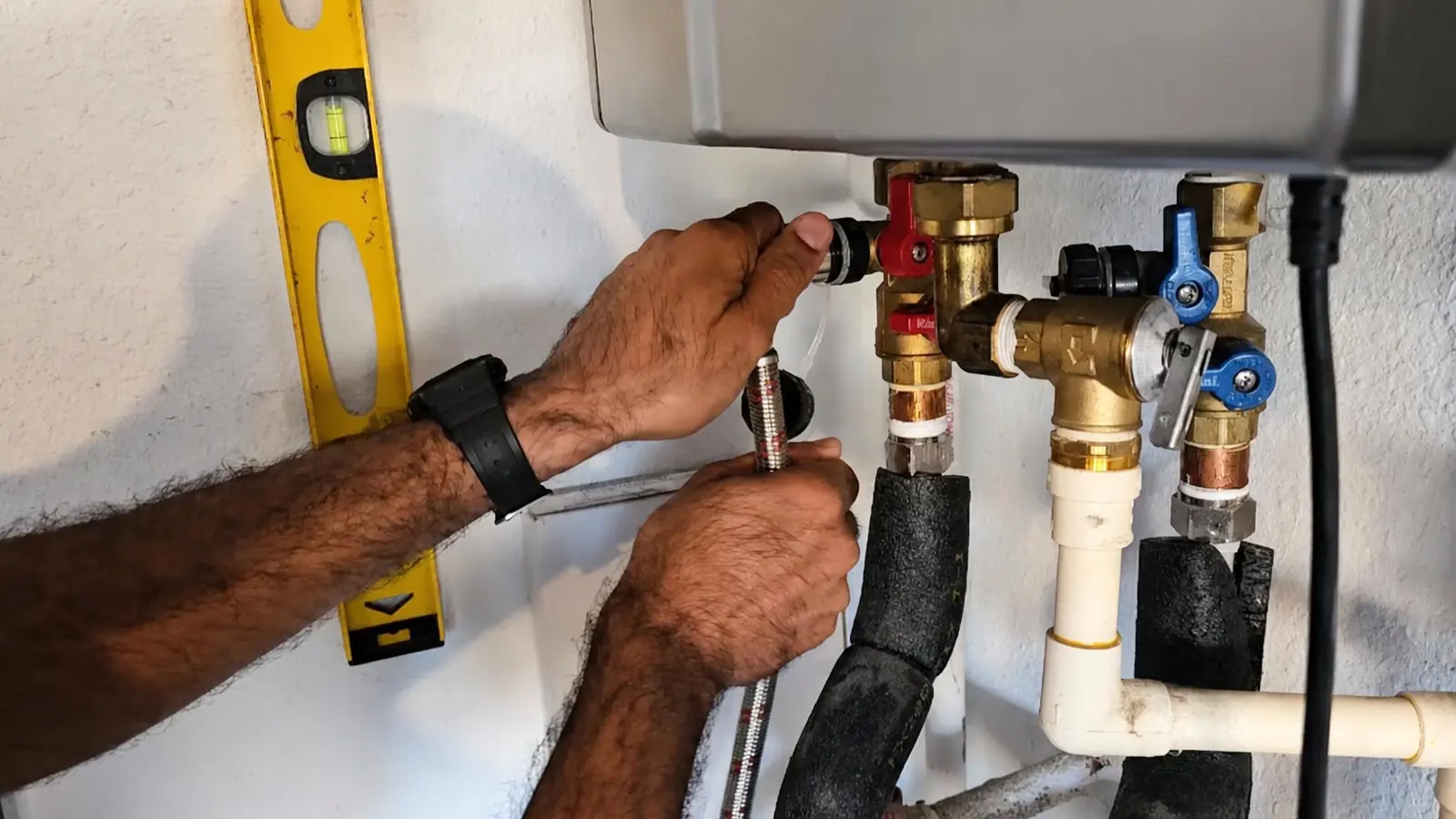
A tankless water heater heats water as it flows, so it never runs out the way a tank can. It also asks more of your gas line, your vent and your water. We install tankless units, repair the common faults and flush the heat exchanger so scale does not shorten its life.
How a Tankless Heater Works, and Why It Matters
When a hot tap opens, a flow sensor fires the burner and water passes through a heat exchanger, a coil of tubing that moves heat to the water. There is no storage tank, so there is no standby heat loss and no tank to rust through.
The trade-off is that the exchanger is a narrow passage. Minerals that would settle harmlessly in a tank bake onto the tubing instead, and that scale is the single most common cause of tankless failure.
Gas Lines, Venting and Sizing
Tankless burners pull far more gas than a tank. An older half-inch gas line that served a tank heater often cannot carry enough for a tankless unit, and upsizing means opening walls or running new pipe. Vent material is also specific to the unit, so a plumber should confirm the manufacturer's requirement rather than reusing an old flue.
Questions to settle before a tankless install
- How many fixtures will run at once at your busiest hour?
- Can the existing gas meter and line supply the required input?
- What vent type does the unit need, and where can it terminate?
- Is there a condensate drain nearby for a condensing model?
- Do you want a recirculation loop for faster hot water at far fixtures?
Flushing and Descaling in Magna Water
Magna Water District reported hardness averaging 105 mg/L in 2023, with total dissolved solids averaging 639 mg/L. That is moderately hard water with a lot of dissolved minerals, which is exactly the condition that scales a heat exchanger.
A yearly descaling flush circulates a mild acid through the unit for about an hour and removes the film. Many manufacturers require it to keep the warranty valid, so keep a record. A water softener reduces how fast scale returns.
Error Codes and Common Repairs
| Symptom | Likely cause | Typical fix |
|---|---|---|
| Lukewarm water that fluctuates | Scaled exchanger or low flow | Descale, clean the inlet filter. |
| Ignition failure code | Gas supply or dirty flame rod | Check gas, clean the rod. |
| Unit shuts off at low flow | Flow rate below the minimum | Clean aerators, check the sensor. |
| Exhaust or vent error | Blocked or damaged vent | Inspect and clear the vent. |
| Water too hot or cold in bursts | Mixing issue or crossed plumbing | Diagnose the supply lines. |
If the unit shows an error code, write it down before calling. Many of them point straight to a failed sensor or a gas supply fault, and the plumber can arrive with the right part. For a failed unit that cannot be repaired, a tank swap is covered on the water heater replacement page.
What Affects Tankless Cost
Tankless jobs vary more than tank jobs because the gas, vent and water conditions are all part of the work.
Insurance and your real number
Standard policies usually do not cover a worn tankless unit. Water damage from a sudden leak may be covered. For a figure on your own system, call (385) 488-1892.
Install Standards Worth Knowing
Tankless units add gas and venting loads that tank heaters do not. Utah applies the International Plumbing Code (IPC) with statewide amendments, and your city or county building department enforces it. Gas line size, vent materials and condensate disposal are the details that decide whether an install passes inspection, so ask your plumber to walk through them.
What to do if the unit stops heating
- Write down the error code on the display.
- Check the power, the gas valve and the isolation valves.
- Open one hot tap fully to test the flow.
- Shut the unit off if you smell gas and leave the house.
- Call a plumber if a reset does not clear the code.
Tankless Questions
It suits households that want endless hot water and have room for the gas upgrade. In hard water, you must budget for yearly descaling.
Yes. A yearly flush is the main task, plus cleaning the inlet screen and checking the vent.
Low flow, a scaled exchanger or a mixing problem at a fixture can cause cold slugs. A plumber can test each cause.
Yes. It usually means a bigger gas line and a new vent, so the quote covers those. See water heater installation for general planning.
It depends on the unit's flow rate and your incoming water temperature. A plumber can size it to your fixtures.
Time for a Tankless Flush?
Call to schedule a descaling visit before scale builds up.